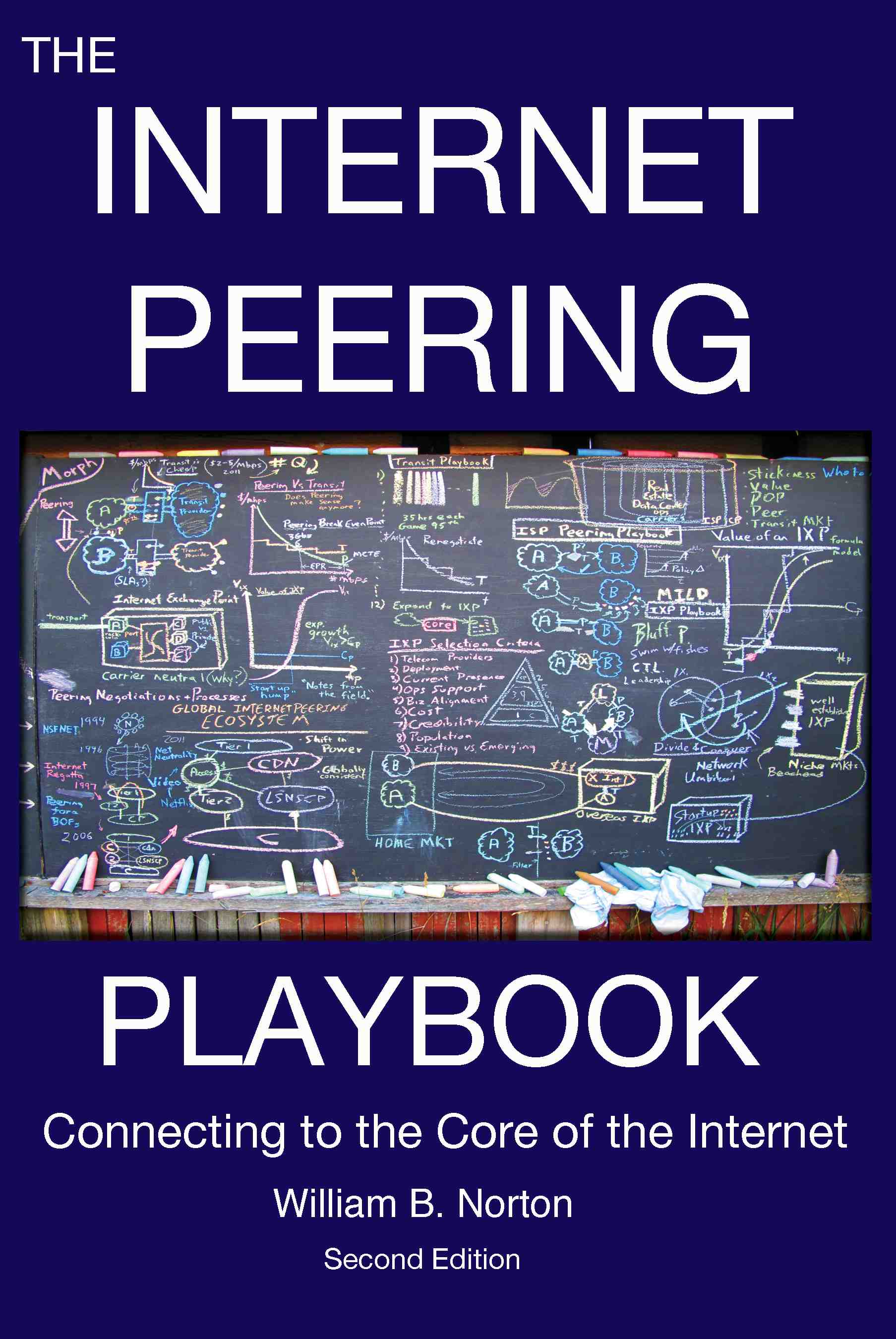
This recently released (August 2011) book is essential reading for anyone seeking to understand network neutrality, the underlying Internet architecture, the previously undocumented art of peering that occurs at the core of the Internet. Those that peer can enjoy optimized network routing, lower latency anda lower cost Internet traffic exchange. This is how the big players (Comcast, Google, Verizon, Yahoo!, Facebook, Akamai, LimlLight, etc.) connect to the Internet.
Networks of scale, peer. And this si the only book in the world that focuses on the practice of Internet peering.

One can understand the protocols, the technologies, and the routing algorithms, but that doesn't tell the story. The Internet is a global ecosystem of cooperating and competing networks, strategically interconnected to maximize performance and minimize costs. If you are operating a growing Internet service, it is essential that you to understand how the Internet Peering Ecosystem works at the core.
You will learn how the largest Internet service companies in the world:
This book will prepare you for connecting to the Core of the Internet. It introduces the terminology and describes the strategies and tactics for Internet Peering, Internet Transit and Exchange Points, collected from some of the smartest peering coordinators and IXP operators in the world.
"destined to be the Internet Peering Bible" – Jeff Turner, InterStream
"The Internet Peering Playbook: Connecting to the Core of the Internet" is an authoritative guide for understanding the complex business relationships inside the Internet and their implications for Internet users. Written by a highly experienced practitioner, the accessible guide is essentially a picture book combining clear verbal and visual narratives. While simple in presentation, the book offers deep insights into the state and evolution of Internet economic affairs. Both descriptive and analytic, the writing incorporates numerous anecdotes and historical perspectives to highlight its crucial points. This unique book is an indispensable read for scientific researchers of the Internet." -- Sergey Gorinsky, Senior Researcher, Institute IMDEA Networks
"I think that the author has done a great service here to a very extended set of networking professionals, that go way beyond the peering community, by writing this book."
"... this is the missing glue between grad/undergrad textbooks on tcp/ip, bgp, and other lower layer stuff, and the corresponding textbooks for application layer network programming etc." -- Nikolaos Laoutaris
"...Finally, I wonder if you may become a target of a hit man You reveal too much about the secrets that are supposed to be hidden among a handful people in the segment." -- Anonymous
""Every chapter contains invaluable information, but I liked Chapter 10 (The 21st Century Internet Peering Ecosystem) best of all. This chapter describes how the major players play their cards to continue to control their influence on the Internet. With the change in the market, some incumbent players have lost out to other guys. And that is well explained in a peering window." -- Dr. Zen Kishimoto
"Bill Norton is one of the rockstars of Internet peering. The Internet Peering Playbook lays the groundwork to help you make peering an integral part of your network strategy." – Steve Ginsberg, Pandora
"The book is a great start to understand peering, the leverage it provides, and the clever ways it is used in the ecosystem. We hand it out to parties needing understanding and guidance and to new personnel." – Job Witteman, AMS-IX
"Essential Reading." – Martin Sanne, SEACOM
"...captures the complexity and subtlety of the economics and technologies of the Internet in a way that is useful for both industry experts and those who are new to the industry." -- Scott Landman, JetStream
"Bill has written a great book which is gives a detailed view into peering (and the dark arts of). I have read the book myself and we have given copies to some of our customers and leads, all have told me how helpful it is and how they gained great knowledge from the book. For someone who wants to know more about peering or is thinking of taking the steps into peering this book is a must have! " -- Jon Waldron
Read the London Internet Exchange book review by Jeremy Orbell:
"It is a long overdue analysis of the trends and developments of peering and the techniques that networks should use to make the most of their peering agreements. It has already proved extremely popular with peering coordinators and network engineers plus those who just want a better understanding of how peering works in practice."
"The Internet Peering Playbook provides a clearly written introduction to how interconnection works at the core of the Internet.
"The book is really interesting. I especially appreciate its simple language, historical perspectives, and notes from the field." -- Sergey Gorinsky
This book was unveiled at the African Peering and Interconnection Forum (AfPIF-2) in August 2011 in Ghana
"Mr. Norton is one of the most knowledgeable people in the world on the subject of Internet Peering – this is a must-read for network operators." – Ari Benowitz, HighWinds
"The book is a great start to understand peering, the leverage it provides, and the clever ways it is used in the ecosystem. We hand it out to parties needing understanding and guidance and to new personnel." -- Job Witteman, AMS-IX
"Great foundation in understanding the basis for ISP peering, interaction, and insight into where those relationships are heading (upcoming challenges)." – David Mindel, Cisco Systems
"Your workshop is still being referred to as the benchmark of most useful technical workshop ever." – Jaco Muller, Head of Technical Operations, MWEB
"I got a lot out of your workshop this week. Very helpful.
I have been around the networking industry since 1983. As an industry veteran, I found your two-day session to be very helpful in understanding the fundamentals of the evolving landscape of Internet peering. The deep domain expertise that you brought to the discussion was applied to some very complex relationships, and you modeled them in a way that demystified the underlying fundamentals. The balance of technical insights blended with the business rationale on how decisions are made in the peering environment was very helpful.
I walked away from this workshop with a clear understanding of the underlying principals of Internet peering, the business rationale for how decisions are made, and a deep appreciation of the evolution that is underway as video transport begins to dominate the Internet." – Mark Canha
"As my company has ventured into peering, the Dr. Peering website provided invaluable information to get us started, since there were really no books on peering, Now, I can say William Norton really has 'written the book' on peering!" – Bob Bender, CTS Telecom
William B. Norton is an internationally recognized expert on Internet Peering with over two decades of experience working on the core of the Internet. He served as the North American Network Operators Group (NANOG) chair, Co-Founder and Chief Technical Liaison for Equinix, and is currently the Executive Director for DrPeering, a leading Internet Peering consultancy.

The author at the book release signing August 2011.
Now entering its 3rd printing. Read about the front cover artwork
There are 3 ways to get the book:
Printed Book
|
Amazon.com
DrPeering.net |
$49.99 $49.99 + shipping ($55 total in the U.S.A. and $64 internationally excluding any duty your country will request from you). In both cases, paid using PayPal) |
eBooks
Kindle (Mobi) ISBN: 978-1-937451-03-5
PDF ISBN: 978-1-937451-01-1
Nook ISBN: 978-1-937451-04-6 |
Amazon.com Apple iBookStore or lulu.com DrPeering (both PDF+ePub included, shared via DropBox) Barnes & Noble |
$9.99
$9.99
$9.99 (paid using PayPal)
$9.99 |
OR BOTH Printed Books and auto-updated eBooks bundle
Print ISBN: 978-1-937451-00-4 + EPUB ISBN: 978-1-937451-02-8 + PDF ISBN: 978-1-937451-01-1 Updates included and shared via DropBox invitation |
DrPeering.net |
$52.99 (via PayPal) +shipping ($5 shipping within the U.S. or $15 for shipping outside the U.S.) |
1) Retailers. If you click on the ISBN links below, you will see you can buy the physical book from Amazon.com and the eBooks from Amazon.com for the kindle, from lulu.com or the iBookStore for the iPad, and from Barnes and Noble for the Nook.
Print ISBN: 978-1-937451-00-4 for $49.99 from Amazon.com
Kindle (Mobi) ISBN: 978-1-937451-03-5 for $9.99 from Amazon.com
EPUB ISBN: 978-1-937451-02-8 for $9.99 from lulu.com and teh Apple iBookStore
PDF ISBN: 978-1-937451-01-1 for $9.99 from DrPeering
Nook ISBN: 978-1-937451-04-6 for $9.99 from Barnes and Noble
2) DrPeering Press DropBox. This book is also available as a continuously updated electronic form via DropBox. Use PayPal to send $9.99 to bill.norton@gmail.com and you will be invited to the DropBox folder containing the continually updated .pdf file and .epub. For details, see http://TheCoreOfTheInter.net . This way, you always have the latest version of the document on your desktop!
New November Bundle! Use PayPal to send $52.99 to bill.norton@gmail.com and you will receive both the physical book and be invited to the DropBox folder containing the continually updated .pdf file and .epub.Start reading the eBook today while you wait for the print version to arrive (USPS estimates that most books will be delivered within 6-10 days). And Free Shipping! We will pay for shipping the book to you anywhere in the world, but you may have to pay customs or import duty when it arrives in some countries.
3) Wholesalepricing. A 20% discount ($39.99/book) is available for volume purchases (purchases of 10-book packs) for peering events, speaking events, educational purposes, or with the two-day on-site peering workshop. With volume purchases other options are available (speaking engagements, book signings, consulting, etc.)
This is the only book in the world that covers the practice of Internet Peering and operating Internet Exchange Points at the core of the Internet. If you want to understand how the Internet works at the core, this is the book for you. If you want to understand how Internet Peering works, or how Internet Peering has evolved into the modern Global Internet Peering Ecosystem, then this is the book for you. If you need to understand the underlying dynamics of the Internet infrastructure operators, and determine if it makes sense for your company to connect to the core of the Intermet, then this is the book for you.
Video Interview with Ken Pyle: http://www.viodi.tv/2011/08/31/sneak-peek-of-the-internet-peering-book/
Video interview podcast: "Conversation with Experts"

"The Emerging 21st Century Access Power Peering" chapter is featured in Communications & Strategies, "Net Neutrality, Act II", no. 84, 4th quarter 2011, p.1.
This book is dedicated to the next generation of peering coordinators.

February 5-8, 2012 NANOG 54 in San Diego
February 21-March 2, 2012 APRICOT 2012 in New Delhi
June 3-6, 2012 NANOG 55 in Vancouver, BC
August 2012 - Souith Africa - AFPIF 3 - TBD
October 21-24, 2012 NANOG 56 in Dallas TX
plus many more private and virtual events TBD.
To schedule a book-related event send email to sales@DrPeering.net
Section I - Connecting to the Edge of the Internet
Section II - Connecting to the Core of the Internet
Sectoion III - The Global Internet Peering Ecosystem
Section IV - The Tricks of the Trade: The Playbooks
Context Is Important
Section I – Connecting to the Edge of the Internet
Introduction to Internet Transit
Internet Transit Price Declines
Implementation Model for the Internet Transit Service
Observations about Internet Transit
Chapter 3 – The Internet Transit Playbook
Introduction
Edge "Tricks of the Trade"
Transit Tactic 1 – Optimal Internet Transit
Transit Tactic 2 – Gaming the 95th Percentile.
Transit Tactic 3 – Multi-Homing
Transit Tactic 4 – Renegotiate Multi-Year Contracts.
Transit Tactic 5 – Play the Market
Transit Tactic 6 – Resell Transit.
Transit Tactic 7 – Secret Sauce Transit.
Transit Tactic 8 – Build into Cheap Transit Internet Region..
Transit Tactic 9 – Internet Transit Troughs.
Transit Tactic 10 – Capture Content and Access Customers.
Transit Tactic 11 – Short-Term Transit.
Transit Tactic 12 – Deploy Trial Gear into Operational Environment.
Summary..
Section II – Connecting to the Core of the Internet
Introduction
Internet Peering.
Three Key Points about Internet Peering
The Top Five Motivations to Peer.
The Internet Peering Process..
The IXP Peering Cost Model
A Paid Peering Aside.
Chapter 5 – The Business Case for Peering.
The Cost of Peering.
Calculating the Cost of Peering
Generalized Analysis
The Peering vs. Transit Economics.
Tracking Peering Effectiveness.
Chapter 6 – Selecting an IXP
Introduction
1 – Telecommunications Access.
2 – Deployment Process.
3 – ISP Current Presences.
4 – Operations Support
5 – Business Alignment
6 – Cost
7 – Credibility
8 – Exchange Population.
9 – Existing vs. Emerging Exchange..
10 – Regional Route Strength..
One Final Note
Chapter 7 – Public vs. Private Peering
Introduction
The Top 3 Reasons Public Peering Is Better Than Private Peering.
The Top 5 Reasons Private Peering Is Better Than Public Peering.
Hybrid Approach (Public + Private Peering).
Section III – The Global Internet Peering Ecosystem.
Chapter 8 – The 20th Century Internet Peering Ecosystem
The First Peering..
NSFNET-Era Internet Peering, 1987–1994.
NSFNET Transition Ecosystem, 1992–1996
The Early Commercial Internet Model
Post-NSFNET Internet in the Growing-Pains Era, 1997–1998.
Carrier-Neutral IXPs Replace NAPs.
Summary..
Chapter 9 – The Global Internet Peering Ecosystem.
The Global Internet Peering Ecosystem
The Internet Peering Ecosystem.
The Tier 2 ISP.
The Content Provider. 1
The Base Internet Peering Ecosystem.
Chapter 10 – The 21st Century Internet Peering Ecosystem.
Evolution #2 – Large-Scale Network-Savvy Content Providers Peer.
Evolution #3 – Cable Companies Peer Directly with Large-Scale Network-Savvy Content Providers
Evolution #4 – CDNs Dominate Traffic Volume.
Evolution #5 – The Video Internet Is Activated
Evolution #6 – Access Power Peering.
Section IV – The Tricks of the Trade: The Playbooks.
Chapter 11 – The ISP Peering Playbook.
Introduction
The Graphical Representation of the Plays..
The Internet Service Provider Peering Playbook
Tactic 1. The Extended Direct Approach.
Tactic 2. Internet Transit with Peering Migration.
Tactic 3. The End-Run Maneuver
Tactic 4. Bundle Internet Transit with Peering..
Tactic 5. Buy Transit from Restrictive Tier 1 ISP
Tactic 6. Transitional Paid Peering..
Tactic 7. Partial-Route Internet Transit..
Tactic 8. Play Chicken.
Tactic 9. Traffic Manipulation.
Tactic 10. Bluff Issues.
Tactic 11. Be Open. Loudly..
Tactic 12. Be Everywhere.
Tactic 13. Get Traffic
Tactic 14. Friendship-Based Peering.
Tactic 15. Spam Peering Requests.
Tactic 16. The Honey Approach – Be Sweet
Tactic 17. Purchase a Well-Peered ISP.
Tactic 18. Bait-and-Switch..
Tactic 19. False Peering Outage.
Tactic 20. Leverage Broader Business Arrangement.
Tactic 21. Overseas Power Play
Tactic 22. Construct Peering from Transit
Defensive Peering Tactics.
Tactic 23. Defensive Tactic - Do Not Peer in Your Home Market
Tactic 24. Defensive Tactic - Protect Peering Policy
Tactic 25. Defensive Tactic - Change & Escalate Peering Prerequisites.
Tactic 26. MILD Defensive Tactic
Tactic 27. Congest Transit Pipes.
Peering Tactics That Don’t Work
Chapter 12 – Taxonomy of Data Centers.
The Internet Data Center Model..
The Basic Data Center Model
Real Estate..
Security Systems..
Power Systems
HVAC Systems..
Data Center Operations
The Networked Data Center..
Carrier Data Center
Internet Data Center.
The European IXP Model
The U.S. IXP Model
Chapter 13 – The IXP Playbook..
The Value of an IXP.
A Simple Calculation of the Financial Value of an IXP..
The IXP Playbook Tactics.
Tactics That Manipulate the Value of the IXP.
Tactic 1. Bluff the Size of the Population
Tactic 2. Build a Network Umbilical for Later IXP Migration..
Tactic 3. The Group Buy-In
Tactic 4. Buy-In Key Players.
Tactic 5. Divide and Conquer
Tactic 6. Beachhead Verticals and Niche Markets
Tactic 7. Extend the Dominant IXP
Tactic 8. Prevent Rogue IXPs
Tactic 9. Swim with the Fishes..
Tactic 10. Bundling.
Tactic 11. Build and Maintain Population Stickiness..
Tactic 12. Strengthen Peering Population..
Tactic 13. Demonstrate Leadership
Tactic 14. Purchase Data Center During Downturns..
Tactic 15. Drop Peering Cost.
Tactic 16. Price on Value.
Summary..
Chapter 14 – The Future
Evolution Continues.
Appendix – The Peering Simulation Game.
Introduction
The Origins of the Peering Simulation Game
In a Nutshell.
Introduction and Definitions
The Players
The Game Board.
Goal..
Play..
Peering Negotiation
Peering Matrix..
Special Adjustments.
Summary..
Strategies Seen in the Game.
How This Simulation Is Different from Peering Reality..
Index.
About DrPeering Press
This is an exciting time to be working on the Internet. Today hundreds of millions of users are connected to this global network, using it as part of their daily workflow. Many of the most innovative applications reach viral popularity literally overnight, and multi-millionaires are being made every day.
Many of these emerging services grow to require better than commodity Internet services purchased at the edge of the Internet. To continue the wave of mass adoption, these services require flawless performance at massive scale, achievable only by connecting directly to the core of the Internet. Massive volumes of Internet traffic are exchanged at the core of the Internet in a sort of open Internet transit marketplace. This area is where the largest Internet Service Providers (ISPs) in the world interconnect, where the largest content providers interconnect with the largest regional ISPs, where the content delivery networks offload their traffic directly onto the broadband networks. The information and strategies described in this book will enable the next generation of Internet services companies to connect to and leverage the performance benefits at the core of the Internet as well.
This book is the assimilation of thousands of discussions with hundreds of the smartest peering coordinators in the world. I spent over a decade on the road, travelled to almost every continent, racking up over 500,000 air miles and spending over $500,000 in travel budget. I attended every Internet Operations conference so I could understand how Internet interconnection worked and document what I learned. I documented what I learned, citing the sources when allowed, and then walked others through the white paper to see if I got it right. After about 100 walkthroughs, I had a white paper that documented a particular aspect of Internet interconnection. Over 10 years I went through this process to produce 12 peering white papers. This base research is the raw source material for this book.
The information contained in this book is valuable. As a consultant, I help executive teams build effective peering and transit strategies. I also advise investors on the core Internet industries (ISPs, carriers, colocation centers, IXPs, CDNs, etc.). For these engagements I am paid quite a bit, and about 70% of the information I provide during these consulting engagements is information contained within this book. The rest of the information is provided on-site as the teams develop their strategies and investment theses. On-site consulting costs a lot of money, but to these teams, collectively, their time is worth a lot more money. They prefer a two-day on-site consulting engagement where they learn together and develop a strategy based on the information I collected during the last couple of decades. Internet interconnection and colocation is a highly specialized area of expertise, and there are only a few of us that can deliver this type of on-site consulting. This book provides this proven valuable information in a much more cost-effective package.
My hope and expectation is that this material will help the next generation of peering coordinators, network engineers, network architects, and business leaders understand and leverage the power of peering at the core of the Internet.
This book is not about technology. There are many great books about the protocols, hardware, and algorithms. One can look at the protocols, the hardware, and the algorithms, but that doesn't tell the story about how the Internet works at the core.
This book is about the core of the Internet, the relationships between the companies that operate the central infrastructure, the "interconnection machinery" that makes the Internet work. It describes the business relationships that simultaneously demonstrate symbiosis and grudging interdependence. This book models the Internet as a Global Internet Peering Ecosystem, and describes the players, their power position, and the corresponding motivations and, indeed, predictable behavior.
This book includes everything you need to know about the Global Internet Peering Ecosystem to make the critical decision: when and why does your company need to connect to the core of the Internet? Some parts of this book will be of interest to you immediately, and some parts will be of interest to you later on. All of it is essential for business people, executives, and technical staff focused on the Internet.
Together, we will take an outward-in view of the Internet.
Section I Connecting to the Edge of the Internet
Section II Connecting to the Core of the Internet
Section III The Global Internet Peering Ecosystem
Section IV The Tricks of the Trade: The Playbooks
We will start by looking at how most companies attach to the edge of the Internet, and learn about the industry terms. We then dive into the core of the Internet, where the largest ISPs and content companies in the world peer their networks. Then we take a 30,000-foot view on the Global Internet Peering Ecosystem, and recognize the commonalities across the globe. With this holistic view of the Global Internet Peering Ecosystem, we will finish by examining the "Tricks of the Trade"—the playbooks collected from some of the smartest peering coordinators and Internet Exchange Point Operators in the world. These playbooks document how ISPs obtain peering where they otherwise would not have been able to. The IXP playbook documents how the smartest IXPs build, grow, maintain, and attack or defend their critical mass of peering participants.
This book takes the reader beyond "The Internet is a network of networks" and documents the internal workings of Internet interconnection and the strategic nature of these interconnections. This information is essential for any Internet services company building out at scale.
This book is for anyone who wants to learn how the core of the Internet works.
Internet Service Providers will benefit from understanding the methods and clever maneuvers surrounding interconnection used around the globe. This book highlights some of the issues and clever tactics that seasoned peering professionals see after years in the field.
Internet Exchange Point Operators (IXPs) will find this book helpful for building a peering ecosystem in their facilities. They will also better understand their customers’ mindset and motivations. This book presents the financial value proposition that Internet Exchange Point Operators provide to customers. The business case for peering at an Internet Exchange Point is clearly explained. Most important to IXPs, this book documents the tactics that the smartest IXPs in the world have used to build and grow, attack and defend a critical mass or peers. This material has been used as training material for IXP staff as well as for their customers and investor base.
Hardware vendors have found this material of practical value for better understanding their customers’ deployment environment, their applications, and their motivations. While this book was not written explicitly for this audience, the larger network equipment manufacturers are now becoming keenly interested in this material.
Students have used the previously released white papers in their classes for years. This book, rewritten from this earlier material, provides a good starting point for understanding the Internet core. The book provides a pragmatic industry view on interconnections that are essential for identifying research projects that are relevant.
Investors in colocation, data centers, IXPs, or large-scale Internet services will find this book to be an invaluable resource in understanding how the Internet actually works at the core.
This book is an assimilation of thousands of discussions with some of the brightest peering coordinators in the world between 1994 and 2011. A subset of these people is listed in the acknowledgements. Many more of them provided valuable data and insights but asked to remain anonymous. What you hold in your hands represents over fifteen years of primary research.
Notes from the field.
Stories and Anecdotes to Make a Point
Throughout this book I include stories and anecdotes that illustrate a particular point. I will format them as I do here to set them apart from the generalizations made in the book. When I consult with clients and when I present peering workshops, I have found that these stories help bring to life the points presented in the material.
Much of this information was previously documented in my peering white papers and remains freely available on the DrPeering website. This research has been used at universities around the world. The research has been updated and the text rewritten and edited for clarity and readability.
In The Grand Design, Stephen Hawkings says that a model is a good model if it is "1) elegant, 2) contains few arbitrary or adjustable elements, 3) agrees with and explains all existing observations, and 4) makes detailed predictions about future observations that can prove or disprove the model if they are not borne out”.
While the modeling of the Internet core as an ecosystem is not of the scale or importance of his work, I believe the Global Internet Peering Ecosystem model is a good model. The model is 1) simple, 2) contains few variables, 3) agrees with the observations made around the world, and 4) provides detailed predictions on the behavior of the parties involved at the Internet core.
The Global Internet Peering Ecosystem has many characteristics of a living ecosystem. There are individual identifiable species that hold power positions within the ecosystem, complete with motivations and predictable behaviors consistent with their position. The ecosystem itself has morphed over time to adjust to the stimulus placed upon it by the customers and their applications at the edge. The scope of this Internet ecosystem is global, so the stakes are very high, and information has been hard to gather. This book uncovers perhaps the most important topics on the Internet today—the evolution of the Global Internet Peering Ecosystem, and are we going in the right direction?
/wbn
Palo Alto, California
All of this work is based on extensive primary research in the field. The previous white papers were discussed with the population, and comments, refinements, and adjustments were made as a result of the feedback. Through this stepwise refinement process, the research more or less accurately reflected the views of the population, or at least the population studied.
Feedback from readers will be a natural part of the process for this book as well. If you have any comments regarding how we could better improve the quality of this book, please send an e-mail to feedback@DrPeering.net and be sure to include the book title and ISBN number in the e-mail subject field.
Thank you for your feedback and suggestions.
"You can observe a lot by watching." – Yogi Berra
Everything I know about Internet Peering is the result of thousands of conversations with some very smart people in the peering coordinator community. All of these folks were exceedingly generous with their time and kind enough to share their wisdom with me over the past fifteen years. Of these people, I want to single out Avi Freedman, my first peering tour guide. He has always been encouraging and consistently very generous with his time and knowledge.
I will take a few pages here to provide credit where credit is due, to those people who have contributed to the creation of this book, to the drpeering.net website, and to the original research.
The Book. Thanks first to Brent Chapman, the first successful author I spoke with, for his encouragement and thoughtful advice over a CA Geek lunch. Thanks to Nigel Holland of the Right On Band for his never-ending encouragement ("Bill - you have to write this book."). Thanks to Will Scott, Scott Landman, Mike Hughes, David Freedman, Tim Pozar, Cat Hoffman, Michael Barrow, and Jeff Turner for their thoughtful and in some cases, very detailed reviews. Thanks to Kyle Van Beveren for his playbook metaphors as a football quarterback and to Alan Hannan for his early feedback as well. A lot of folks have contributed ideas, including Mike Hughes (formerly LINX), Cat Hoffman (Equinix), Dave Meyer (Cisco), Craig Pierantozzi (Level 3), Jonathan Heiliger (Facebook), Raphael Ho (Equinix), Job Witteman (AMS-IX), Frank Orlowski (DE-CIX), Christian Nielsen (Microsoft), Andre Retief (MWEB), Edward Punt (KPN), Sven Engelhardt (TiNet), Frédéric Libotte (BNIX), Pierre Bruyère (BELNET), Jon Terreele (BELNET), James Blessing (LimeLight Networks), and Peter Harrison. Thanks especially to Bonnie E. Hupton for editing this book. She turned my manuscript into a much better book.
The DrPeering.net Site. I also want to thank those who provided ideas, suggestions, and feedback to the ever-evolving DrPeering.net web site. Frank Orlowski (DE-CIX) and I had our first conversations about writing an "Ask DrPeering" column at a GPF in the Dominican Republic. I wanted a web site for hosting the peering white papers. Combining these two, and the Dominican Republic Peering (DrPeering) idea was hatched. Thanks also to Chris Park (EasyNet), Randy Epstein, Richard Steenbergen (nLayer), Ren Provo (Comcast), and Joe Provo (ITA) for their suggestions about the site over the last few years.
The Original Peering White Papers. Most of all, thanks to all of the generous folks who have contributed their data points and their insights, citable or with anonymous attributions, during the fifteen years I spent in the peering world. All of the research in this book and in the white papers is based on these conversations in the field. All of this material has been rewritten and remains freely available on the http://DrPeering.net web site, a site sponsored by DE-CIX since the beginning.
Many contributors to the white paper research are listed in the following paragraphs. I would like to point out that not only have these people contributed to my research, but they are the ones who consistently volunteered their content, time, and promotion of the peering events that I ran at NANOGs, APRICOTs, Gigabit Peering Forums, etc. Without these contributions this book would not exist.
(The companies in the parenthesis represent the affiliation of the individuals at the time of the white paper walkthrough – many of these people have changed jobs, and in some cases have changed names as well.)
Internet Service Providers and Peering: Ren Nowlin (Onyx networks), Joe Payne (IXC), David Diaz (Netrail), Jake Khuon and Alan Hannan (Global Crossing), Dan Gisi and Jeff Rizzo (Equinix), Patricia Taylor-Dolan (Level 3), Sean Donelan (AT&T Labs), Avi Freedman (AboveNet), Patrick Gilmore (Onyx), Geoff Huston (Telstra), Steve Meuse (GTE), Aaron Dudek (Sprint), Raza Rizvi (REDNET), Wouter van Hulten (InterXion), Michael Palmaffy (Equinix), Beau Sackett (Telus), and Martin Levy.
The Business Case for Peering: Jeffrey Papen (Yahoo!), Mitchell Rose (Digital Island), Dennis L. Shreve (FACET Networks), Jon Castle (Comdisco), Jeff Swinton (Conxion), Jalil Sanad Halim (9 Telecom), Glen Larwill, Nick Monjo (PSINet Australia), Tim Griffin (AT&T Research), Rene Hatem (CA*net3), Todd Braning (Level 3), Joe Klein (Cogent), Ren Nowlin (Carrier1), Joe Provo (RCN), Vince Fuller (MFN), Mike Leber (Hurricane Electric), Brokaw Price (Yahoo! Broadcast), Waqar Khan (Qwest), John Osman (rigozsaurus.com), Mike Hughes (LINX), Ted Hardie (Equinix), Lane Patterson (Equinix), Jason Starr (Equinix), Nic Lewis (AduroNet), Wolfgang Tremmel (via Net.Works), John Zweibel (Procket networks), James Rice (BBC Internet Services), Beau Sackett (Telus), and Martin Levy.
The Great Public vs. Private Peering Debate: Peering at 10G: Ren Provo (SBC), Richard Steenbergen (nLayer), James Rice (LoNAP), Todd Underwood (Renesys), Stephen Wilcox (TeleComplete), Vanessa Evans (LINX), Niels Bakker (AMS-IX), Chris Malayter (TDS Telecom), Patrick Gilmore (Akamai), Frank Orlowski (T-Systems), Vijay Gill (AOL), Vish Yelsangikar (NetFlix), Nathan Hickson (eBay), Steve Feldman (CNet), Lane Patterson (Equinix), Joy Fender, Falk Bornstaedt (T-Systems), Remco Donker (MCI), Danny McPhearson (Arbor Networks), Josh Snowhorn (NOTA), Vince Fuller (Cisco), Philip Smith (Cisco), Andrew Odlyzko (UMN), and Martin Levy.
The Video Internet: The Next Wave of Massive Disruption to the U.S. Peering Ecosystem: Vish Yelsangikar (NetFlix), Peter Harrison (NetFlix), Aaron Weintraub (Cogent), Jon Nistor (TorIX), Barrett Lyon (BitGravity), Dave Knight (ISC), Aaron Hughes (Caridien), David Filo (Yahoo!), Jim Goetz (Sequoia Capital), Jason Holloway (DoveTail), Matt Peterson, Richard Steenbergen (nLayer), Lane Patterson (Equinix), Eric Schwartz (Equinix), Pete Ferris (Equinix), David Cheriton (Sun), Andy Bechtolsheim (Sun), Jeffrey Papen (Peak Web Consulting), KC Broberg (Rackable), Henk Goosen (Sun), Geoffrey Noer (Rackable), Jeff Turner (InterStream/nuMetra), Vab Goel (NorWest Venture Partners), Ken Hubbard (Quad), Matt Wood (Equinix), Gary Baldus (Limelight Networks), Sylvie Laperriere (VSNL), Ted Seely (Sprint), Bryan Sutterfield (Cox), Patrick Gilmore (Akamai), Phil Thomas (Quad), Doug Wilson (Microsoft), Christian Nielsen (Microsoft), Harald Willison (Covad), Davin Overland, Douglas Galbi (FCC), Ren Provo (AT&T), Susan Martens (AT&T), Richard Clarke (AT&T), the Google Network Engineering and Network Architecture team, James Blessing (Entanet), Sean Donelan (Akamai), Allan Leinwand (Panarama Capital), and Patrick McCullough (Prism VentureWorks).
The Evolution of the US Peering Ecosystem: Ren Nowlin (SBC), Christina Chu (NTT/Verio), Joe Zhu (China Telecom USA), Joe Provo (RCN), Terry Manderson (APNIC–formerly from Optus), Dave McGaugh (PCCW/BTN), Philip Smith (Cisco), Keith Mitchell (ExchangePoint), Fumio Terashima (Japan Telecom America), Geoff Huston (Telstra), Patrick Gilmore (Akamai), Jonathan Chou (Equinix), Phil Grasso (NTT), James Spenceley (Comindico), Chris Chaudry (Comindico), Gavin Tweedie (WAIX), Lloyd Taylor (Keynote Systems), Tatsuo Sato (KDDI America), Sam Habash (SuperNews), Joe McGuckin (Via.Net), Mike Leber (Hurricane Electric), Morgan Snyder (Equinix), Eric Bell (Time Warner Telecom), Peter Cohen (Telia), Dan Golding (AOL), Alexander Tudor and Lance Tatman (Agilent Labs), Eric Aupperle (President Emeritus, Merit Network), Dave Meyer (Sprint, Cisco), Michel Py, Keith Young, Nenad Trifunovic (MCI), Sean Butler, Marcellus Nixon (XO), Mark Seery, and Martin Levy.
The Asia Pacific Peering Guidebook: Lionel Taylor (Reach), Ren Nowlin (SBC), Brokaw Price (Yahoo!), Christian Nielsen (Microsoft), James Spenceley (Comindico), Geoff Huston (Telstra), John Milbourne (Newton Technology Partners), Tom Vest (formerly of AOL Asia), Zwickey Cheung (Asia Netcom), Nigel Titley (FLAG Telecom), Joe Abley (ISC), Norman Hoy (MCI), Gavin Tweedie (WAIX), Ryan Sher (FLAG Telecom), Marcellus Nixon (XO Communications), Stuart Deane (AT&T Asia), Sylvie Laperriere (TeleGlobe), Peter Cohen (Telia), Bill Woodcock (PCH), Phil Koen (Equinix), Jonathan Chou (Equinix Asia), Bob Berger (MetroFi), Toshikazu Saito (POWEREDCOM), Lam Hon Kit (Asia Netcom), Akinori Maemura (France Telecom), Fumio Terashima (Japan Telecom), Dorian Kim (NTT/Verio), Christina Chu (NTT/Verio), James Seng (Singapore IDA), Steve Baxter (PIPE Networks), Marty Gauvin (Hostworks), Phil Tsakaros (Pacific Internet), Sean Carlin (Microsoft), Randy Whitney (MCI), Joe Zhu (China Telecom USA), Joe Provo (RCN), Terry Manderson (APNIC, formerly Optus), Dave McGaugh (PCCW/BTN), Philip Smith (Cisco), Keith Mitchell (XchangePoint), Patrick Gilmore (Akamai), Phil Grasso (NTT), Chris Chaudry (Comindico), Lloyd Taylor (Keynote Systems), Tatsuo Sato (KDDI America), Sam Habash (SuperNews), Joe McGuckin (via.net), Mike Leber (Hurricane Electric), Peter Juffernholz (T-Systems, formerly TeleGlobe), Jeremy Deutsch (Equinix), Sameer Muhammed (Qatar Telecom), Rob Seastrom (ClueTrust), Mike Hatfield, Guy Tal (Global Crossing), Jerry Murray (Global Voice Network), and Jamie Baddeley (fx.net.nz).
The Art of Peering: The Peering Playbook: Joe Klein (Adelphia), Ren Nowlin (SBC Internet), Mitchell Rose (Digital Island/Cable & Wireless), Peter Cohen (Telia), Stephen Stuart (MFN), Jeffrey Papen (Yahoo!), John Harkin (ATG), Ingrid Erkman (ICG), Jeb Linton (EarthLink), Paul Nguyen (Google), Paul Vixie (PAIX), Peter Juffernholz (TeleGlobe), Michael Winslow (Williams), Blake Williams (Williams), Scott J. Ellentuch (TTSG Internet Services), Chris Cousins (Carrier1), Michel Py, William F. Maton, Raven Alder (Intermedia), Kevin Epperson (Level 3/University of Colorado), Geoff Huston (Telstra), Joe St Sauver, Eric Aupperle (formerly President of Merit), James Rice (BBC Internet Services), Mike Hughes (LINX), Josh Horn (Terramark NOTA), Andrew Partan, Eric Anderson (BT Ignite), Chris Sandford (INS), Avi Freedman (Akamai), several folks who asked not to be recognized for contributions, and Martin Levy.
The Folly of Peering Ratios: Peter Cohen (Telia Sonera), Richard Steenbergen (nLayer), Patrick Gilmore (Akamai), Vikas Mehta (AOL), Bryan Garrett (BellSouth), Brian Sutterfield (Cox), Kevin Mulvahill (Equinix formerly from @Home), Steve Wilcox (Telecomplete), Louie Lee (Equinix), Brokaw Price (Yahoo!), Joe Provo (RCN), John Curran, Hamish MacEwan (CityLink), Brandon Galbraith, Maureen Carroll (T-Systems), Vince Fuller (Cisco), Joshua Sahala (TWTC), and Ren Provo (SBC).
Do ATM Exchange Points Make Sense Anymore? Dorian Kim (NTT/Verio), Ingrid Erkman (ICG), Dave McGaugh (ELI), Eric T. Bell (Time Warner Telecom), Chris Parker (StarNet), Lane Patterson, Jay Adelson, Morgan Snyder, and John Hardie (Equinix), David Diaz (BellSouth), Joe Wood (Accretive Networks), Robert Seastrom (inter.net), Kevin Epperson (Level 3), Petri Helenius (FICIX), Scott Sheppard (BellSouth), Ralph Doncaster (iStop.com), Leo Bicknell (ufp.org), Paul Vixie (vix.com), Ian Somerton and Dave Wodelet (Shaw/BigPipe), Tony Hain (Cisco), Jeff S. Wheeler (five-elements.com), Cliff Hafen, Dory Liefer, Shannon Lake (Omnivergent), Nenad Trifunovic (WorldCom), Andre Gironda (eBay), Jeb Linton (EarthLink), Daniel Golding (SockEye), Peter Moyer (Juniper), Louis Lee (Equinix), Waqar Khan (Qwest), Andrew Odlyzko (UMN), and Gary Blankenship (Foundry).
The Art of Peering: The IX Playbook: Chris Quesada (PAIX/Switch and Data), Josh Snowhorn (NAP of the Americas/Terremark), and Randy Whitney (UUNet).
I would also like to thank Elise Gerich, who, during my days at Merit Network, had faith that I could write the NANOG business plan and assume the role of chairing NANOG. I grew into that role, which after three years positioned me to take on the startup adventure with the title of Co-Founder and Chief Technical Liaison for Equinix. I spent 15 years researching peering with the NANOG community, so the release of this book can be traced back to that one step Elise took in 1995.
One final and very important thanks to Jay Adelson and Equinix. They allowed me the freedom to travel around the world to research, document, and evangelize peering. No easily identifiable revenue resulted from these activities, and they understood that the information I gathered for the peering community would be made freely available to customers and competitors alike. The whole industry benefited from this collection and dissemination of information on how peering works, and it required vision backed by a hefty bank account to allow me to do this research. Thanks for allowing me to help this community.
/wbn
Palo Alto, California
May, 2011
Much of this book is also browsable at the Google Books site.
The Internet Peering Playbook is now available !
EPub available for your iPad: on Lulu.com
and on the iBookStore and now for the Nook on Barnes and Noble! Available on Amazon.com for the Kindle as well. Print versions of the book are available on Amazon.com or on the DrPeering.net site using PayPal. Volume discounts available for bookstores, peering events and for educational purposes - send e-mail to sales at DrPeering dot net to order 10 or more copies.